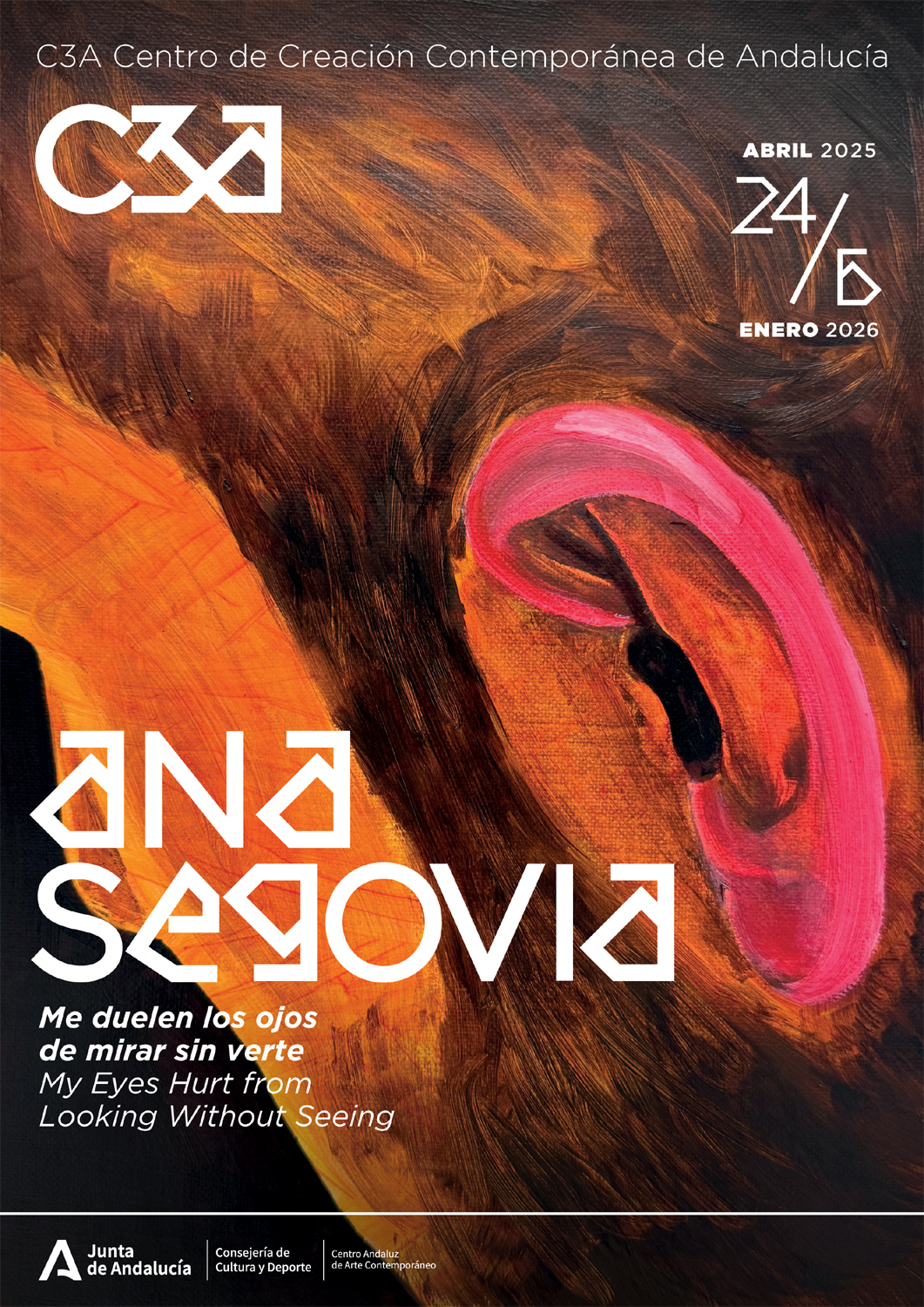
MY EYES HURT FROM LOOKING WITHOUT SEEING. ANA SEGOVIA
MY EYES HURT FROM LOOKING WITHOUT SEEING. ANA SEGOVIA
24 April 2025 - 4 January 2026 .Sala T4
Curated by Jimena Blázquez Abascal
"Si me queréis, ¡irse!". Lola Flores, Spain, 1983
The gaze is a bridge between the visible and the imagined, an act that not only contemplates but also creates. To look is to fill voids with what we desire, with what we know will never arrive but remains ever-present. In My Eyes Hurt from Looking Without Seeing, Ana Segovia (Mexico City, 1991) invites us to inhabit that space between what is seen and what is absent, where absence is not a lack but an echo resonating at the centre of every gaze. Inspired by the film Pena, penita, pena (1953, Miguel Morayta), Segovia constructs a visual narrative through her paintings, in which characters stare toward an empty stage, searching for Lola Flores¿not to find her, but to fill her absence with the power of imagination. Their eyes fixed on the unattainable, their backs turned to the audience, transform the viewer into a witness of something that never arrives but never ceases to be.
Cinematic framing, particularly from the Golden Age of Spanish cinema, inspires both the structure of the exhibition and the aesthetics of this proposal. Segovia subverts this cinematic logic by incorporating stenographic elements within the exhibition space, turning the audience into an active protagonist in the composition. Where classic cinema used close-ups to capture emotion while leaving the frame empty as a space of absence, here the spectator faces a staged environment built in layers, fragmented by a play of curtains that gradually reveal different visual planes. This device, reminiscent of Baroque theatricality and cinematic grammar, reinforces the tension between the visible and the hidden, evoking what Slavoj Žižek (Ljubljana, 1949) describes as the power of the ¿off-screen¿: that which is not directly shown but organizes and defines everything else. In this way, Segovia¿s painting extends beyond the canvas, transforming the viewer¿s experience into a succession of revelations, where absence and presence are constantly constructed through layers of veiling and unveiling.
Ana Segovia¿s painting is rooted in an aesthetic where chiaroscuro becomes an expressive tool that goes beyond light and shadow¿it is a space where absence and presence engage in dialogue. The palette in this series of paintings, dominated by ochres and earth tones, recalls the material solidity of Baroque painting, where light emerges from the depth of colour, sculpting the bodies and imbuing them with an almost sculptural weight. These earthy tones are interrupted by unexpected bursts of colour: acidic pinks, incandescent yellows that seem to vibrate on the canvas, breaking the darkness with an almost unreal intensity. This contrast, characteristic of tenebrism yet subverted by a contemporary sensibility, not only illuminates the folds of clothing or the contour of an ear with choreographed drama but also reinforces a spectral quality, evoking what is simultaneously present and vanishing. As in Baroque painting, where the theatricality of light guided the viewer¿s gaze toward the essential, Segovia¿s exaggerated luminosity in certain details forces the audience to linger on what would otherwise go unnoticed, transforming each fragment into a stage in itself.
In the paintings, the empty stage becomes the nucleus of the narrative, a space charged with tension where absence takes form. The characters, with gazes that convey desire, frustration, and an almost religious devotion, stare at a point where Lola Flores should be, but is not. Yet her absence is not silent; it is a latent presence that dominates the scene without needing to be shown, as if the very act of looking makes her reappear with each observation. In this interplay of absence and presence, Segovia not only reflects on the act of looking but also makes it the core of the experience. Her characters, positioned with their backs to the audience, reinforce this idea by transforming the spectator into an external witness¿an intruder observing those who observe. Through this device, the painting becomes performative, unfolding a choreography of gazes where the visible and the imagined intertwine. Lola Flores's absence is not a lack but an echo that resonates within the pictorial space, a void that never ceases to be present.
Andalusian folklore, with its inherent theatricality, provides the emotional framework for this proposal. Copla and flamenco, deeply performative traditions, do not merely express emotions; they dramatize them, turning them into symbols. Lola Flores, as a central figure in this tradition, was not just a performer but an icon whose presence transcended the stage. In Pena, penita, pena, her figure was the epicentre of the narrative; here, her absence amplifies her significance, transforming her into a myth that inhabits both the visible and the imagined.
The Baroque theatricality, with its play of perspectives and its fascination with what remains unseen, structures the series of paintings in this exhibition. By turning their backs on the audience, Segovia¿s characters invite the viewer to occupy the space of the absent, to confront the tension of looking without being seen, of contemplating a scene whose meaning always remains just out of reach. This interplay of perspectives creates a choreography of gazes where the void is not merely observed but filled with the projections of those who contemplate it.
My Eyes Hurt from Looking Without Seeing is not just an exhibition about absence, but about what that absence generates. By confronting us with an empty stage where characters gaze at the unattainable, Segovia turns the act of looking into a deeply active experience. Here, emptiness is not silence but a space where desire, memory, and imagination converge. As in cinema and in life, what is absent defines what is present, reminding us that absence is not a void but a form of presence that never ceases to resonate.
Image gallery